Saturday, February 11, 2012

 Striated Heron (formerly known as Little Heron) 
(Butorides striatus)


(Note: a kind reader pointed out to me that this is the Striated Heron or Little Heron and not the Black-crowned Night Heron)


Revisiting one of my favourite bird watching sites, the Pasir Ris Park, after the Chinese New Year was somewhat of a let-down after all the earlier excitement of seeing the Mangrove Pitta, Spotted Owl and Pied Hornbill there.


It was quite late in the afternoon but the sun was still shining brightly through the mangrove trees with rays of brilliant light piercing the canopy. Not much was in sight except for small crabs and mud skippers, and the call of the kingfishers was in full blast.


Suddenly, a small movement momentarily caught my eyes. Standing still and quietly in order to not startle whatever it was, I spied a skinny hen-sized bird moving among the mangrove roots. Dark bluish on top with a white body and pointy beaks. Through the binoculars, I saw this fairly common water bird, the Striated Heron or Little Heron having a late afternoon snack, pulling long slimy things out of the mud.


Here's a video recording of it.


End
2012: Lifer No. 7


Watercock
This one's female but it's not called a Waterhen


Watercock (front), Waterhen (rear); they are not related
THE birders' forum was abuzz earlier this week with a new sighting of a rarely-seen bird, a Watercock (Gallicrex cinerea), in Singapore.

The water fowl was spotted at the Eco Park within the Singapore Botanic Gardens.
Wikipedia says it is a "waterbird in the rail and crake family Rallidae.  It is the only member of the genus Gallicrex.


"Their breeding habitat is swamps across south Asia from India, Pakistan, and Sri Lanka to south China, Japan and Indonesia."
Gorgeous feather markings
Despite being endemic to this region, knowledgeable birders say it is rarely seen here. The one in the photo is a non-breeding female. 
The male "have mainly black-grey plumage with red legs, bill, forehead shield and horn.
"They nest in a dry location on the ground in marsh vegetation, laying 3-6 eggs. These large rails are mainly permanent residents throughout their range.
"The body of this rail is flattened laterally to allow easier passage through the reeds or undergrowth. It has long toes and a short tail.
"These birds probe with their bill in mud or shallow water, also picking up food by sight. They mainly eat insects and small fish and seeds. They forage on the ground.
Pointy face, smallish head

"Watercock are quite secretive, but are sometimes seen out in the open. They are noisy birds, especially at dawn and dusk, with a loud, gulping call."
The Watercock was observed to want to stay and forage for food round a badelygne of Lesser Whistling Duck (Dendrocygna javanica), also known as Indian Whistling Duck (see footnote) and a pair of Black Swan. But it seems to be less tolerant of the common White-breasted Waterhen (Amaurornis phoenicurus) and would chase it away when it got too close.

I am glad this odd-looking bird adds to my list of lifers for this year.

Footnote: The Lesser Whistling Duck (photo below), also known as Indian Whistling Duck, is a small whistling duck which breeds in South Asia and southeast Asia. It may also be called the Lesser Whistling Teal (based on an older classification), or the Tree Duck. This duck is usually seen at the end of the year until the first few months of the new year.

Ends

Friday, January 13, 2012

@ Pasir Ris Park - January 12, 2012


Couples
Love's in the air


AT around noon, a pair of Oriental Pied Hornbill (Anthracoceros albbirostris) made their presence felt when they flew overhead with their distinctive steam locomotive sound as they flapped their wings (whoosh, whoosh). Quickly following the sound I soon spotted them, large as life and just about three metres up on a tree, feasting on red berries. In my excitement, I forgot to ID the tree.

This wasn't my first sighting of this hornbill specie (the first was at the Singapore Botanic Gardens, two years ago) but it was the first sighting of a pair - a male and female. I suspect they are a breeding pair as the larger male would occasionally offer a berry to the female and making soft calls to it. It was certainly a romantic sight.

What especially thrilled me was the birds' absence of fear of the few human beings who were around - roller bladers, courting couples and me with my camera pointed at them. 

At one stage, the female flew to a nearby tree and I found myself standing between the two. They eyed me all the time, then the female turned its back to me while I happily snapped away. The male finally couldn't stand the separation any longer and flew to the tree where the female stood on. He flew low and close, he was a mere metre away from me. What a terrific experience it was to feel the wind as he flapped his broad wings as he flew passed.

One for me ...
And one for you
Lady-is-Waiting

Further up the path, a streak of brilliant turquoise blue suddenly zipped past. That could only mean one thing - there was a Collared Kingfisher (Todiramphus chloris) about. 

But what I did not expect to see was a pair of them sitting on the same branch, some 20 metres away. 

I can't be sure whether they were a courting couple but they certainly stood fairly close to each other for a good 10 minutes. Not a chirp was heard being exchanged though.

Making goo-goo eyes at each other
Who's there?
Like my new dress?
As I was about to leave the park, a solitary bird was busy hopping about, from vine to bench to grass. It was lunch time and it attacked the rich pickings of insects. It was a glossy black-topped and white-bellied bird, which turned out to be an Oriental Magpie Robin (Copsychus saularis, below). Again, this bird showed no fear of me and once hopped within three metres from my feet.


Once again, Pasir Ris Park proved to be a really good place for bird watching, you just need a dose of patience and the birds will show themselves and perform for you.


Monday, January 9, 2012

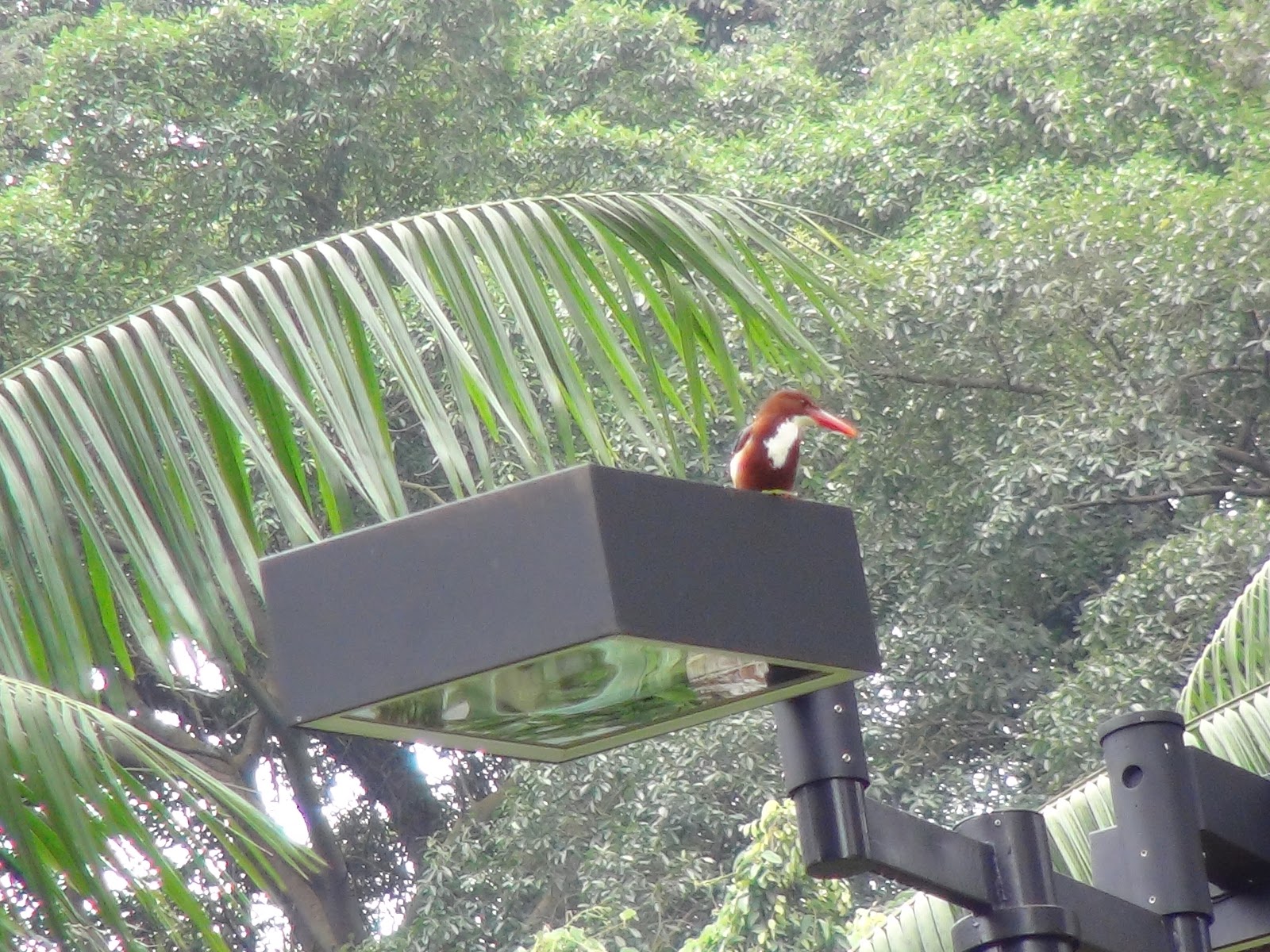
White-Throated Kingfisher


It posed for me
@ Singapore Botanical Gardens

The kingfisher happily shared the roof with a spotted dove
The little kingfisher is one of the most delightful local birds to watch. It is colourful both in looks and personality. It flies swiftly, dives for fish with a small splash and filling the air with its unmistakable call.

One can usually spy a kingfisher or two at the Singapore Botanical Gardens, one of the best places to see birds here. Today, I saw just one - the White-Throated Kingfisher (Halcyon smyrnensis). And what a model it was.

The birds sat for long spells on the stage, roof, lamp post and walkway. It would survey its surroundings with watchful, if not curious, eyes. It certainly wasn't jumpy when humans walked past it. So I managed to capture it at the different spots it sat on, once sharing the roof top with a Spotted Dove with nary a push or a shove. Don't you just love its outfit?


2012: Lifer Number 5 & 6


Where have the birds in Sungei Buloh gone to?


Foraging Milky storks (first three from left) watched by a pair of Painted storks. A small Sandpiper fronts the flock.
I guess we were a tad too late to see the rich collection of migratory water birds at Sungei Buloh. This morning, at 7.30 a.m. my niece, Jan, and I presented ourselves at the gates when it opened. We were the only two visitors there and had the whole wetland reserves to us. Bird calls, the sound of the incoming tide and the wind in the trees accompanied our stroll through it. Besides, the air was cool, which made walking easy.

However, at most hideouts, few of the famed water birds were seen and some had none at all except for mudskippers and noisy mynahs. Yet, for the few birds that still lingered here two were lifers for me, both from the stork family.

One was the Milky Stork (Mycteria cinerea) and the other, the Painted Stork (Mycteria leucocephala). They foraged the waters together and there was no competition between them. The Painted Stork looked larger. Occasionally, they made loud "gok gok" sounds. And when in flight, their wings were large and spread out majestically with beautiful white and black markings. Both storks have pinkish faces and pinkish thin legs. Rather odd looking birds, I think.

The elegant Chinese Egret
Further on, a small number of Chinese Egrets (Egretta eulophotes) were blissfully having breakfast of shore fish and crustaceans in the shallow waters. They were snowy white, had long elegant necks and moved about quietly and elegantly.

We did see herons and the White-collared Kingfisher, plus two sea otters and two juvenile monitor lizards. The latter showed no fear of humans as we walked past them.  What an experience.

Hopefully, the migratory birds will make another pit stop on their way back to the north when spring comes. I would certainly like to see them.

Saturday, January 7, 2012

2012 Lifer Number 4

Banded Woodpecker
@Bukit Brown Cemetery, Singapore


Banded Woodpecker looking for breakfast on a vine
This morning, the Nature Society of Singapore conducted a bird watching trip in the Bukit Brown Cemetery, which the government has proposed to build a motor expressway through it. Something that has gotten many nature lovers upset as this is one of the few remaining green lungs in urban Singapore.

This more than a hundred-year-old Chinese cemetery is forested in parts and is rather tranquil. It has paved narrow roads, which makes walking easy. There were quite a number of people riding their horses and walking their dogs. It is rather scenic with its valleys, streams and hillocks. Many prominent early Chinese settlers are buried here, including Ong Sam Leong, Tan Keong Saik, Lim Chong Pang and Tan Kim Ching.

At 8 a.m. the air was filled with bird calls and songs and many birds were flitting here and there. Some, such as the Coppersmith Barbet and Green-necked Pigeons, were sunning themselves on tree tops.

Owing to the thick foliage it wasn't that easy to spot the birds clearly through scopes or binoculars. But you know they are there through the calls they make. Sunbirds, Black-nape Orioles, mynahs, bubuls and koels were among the more commonly seen birds. There were a couple of White Whistling Thrush, which were heard but not seen. One bird guide said that as recently as 10 years ago, I hardly saw the koel, a parasitic bird belonging to the cuckoo family. It likes to lay its eggs in crows' nest. Today, one hears and sees them all over Singapore. Also, the White Whistling Thrush is an introduced bird which the birders don't quite like as it competes with some local bird species for food and territory.

Near the end of our two-hour trek, one of the bird guides alerted us to the presence of a Banded Woodpecker (Picus mineaceus). Ah, the fourth lifer for me in 2012!

For a few fleeting moments, the bird was in clear view as it was hunting for food on a vine hanging down from a large ficus tree. It is a beautiful bird with flame-red wing feathers and brown barred back and underbelly, and red crown. This was probably a male as it had reddish tinge ear-coverts. It was pecking all the time as one would associate with the woodpecker.

But it soon flew off. And I fear may never return when the highway with its noise and pollution invade this green haven in the near future.

Friday, January 6, 2012

2012: Lifer Number 3


Spotted Owl to Hoot Over


Pasir Ris Park is turning to be such a bird haven for me this year. First, it was the Red Jungle Fowl, then the Mangrove Pitta, and yesterday's trip yielded the Spotted Owl (Athene brama). This is my first owl of any kind and my third lifer of the year within the first four days of this new year. Praise the Lord.

Although it was 11 a.m. the owl was wide awake and stared down at us photographers from its high perch in the tree. Nearby was a roundish fluff of beige and white - it was the owlet, and the parent was keeping a watch. The baby has very round eyes like all owls have and it was really cute. The other parent, which was said to be around, was no where to be seen.


One of the photographers said that a while back, the owlet fell off the tree and was on the ground, thankfully uninjured. They quickly took shots of it before putting it back on the tree, out of harm's way - because cats, rodents etc would have this chick for a meal.


I am very grateful that birds are not hunted in Singapore (it's a crime) and so they have flourished to brighten and cheer up our lives. May they continue to do so till the end of time.


Baby